
Egypt’s Most Mysterious Desert Pool
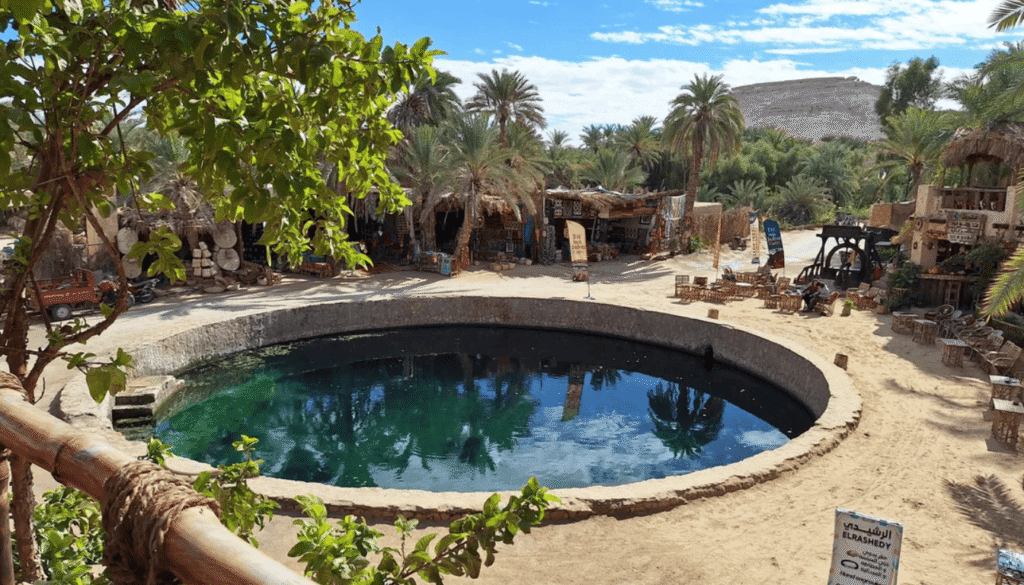
There is a spot in the Egyptian desert where the ground simply cracks open and cold, crystal-clear water bubbles up from somewhere deep beneath the sand. No pumps, no pipes, no infrastructure — just the earth doing what it has apparently been doing for thousands of years. This is Cleopatra’s Spring, known locally as Ain Juba, tucked away 3 kilometers east of Siwa town center and surrounded by a sea of some 300,000 date palms.
Most people who visit Egypt never make it this far west. They come for the Pyramids, for Luxor, for the Red Sea — and they leave without ever knowing that one of the country’s most quietly extraordinary places exists. Siwa Oasis has been inhabited for roughly 10,000 years and has always operated on its own rhythm, distant from the rest of Egypt both geographically and culturally. Getting here takes effort, but that effort is precisely what keeps it special.
In 2026, improved road connections have made the journey slightly easier without turning Siwa into a tourist trap. The oasis remains raw, unhurried, and genuinely off the beaten path. And at its heart, Cleopatra’s Bath in Siwa sits like a secret that the desert has been keeping for centuries.
“Tap here and learn more about Hurghada Marina: Where Luxury Meets the Sea.”
Quick Facts at a Glance:
- Location: 3 km east of Siwa town center, Western Desert, Egypt.
- Water Source: Natural underground aquifer fed by artesian pressure.
- Water Temperature: Constant 29°C–30°C (84°F–86°F) year-round.
- Entrance Fee: Free | Open 24 hours, 7 days a week, all year.
The Legend: Did Cleopatra Really Bathe Here?
Here is where history gets deliciously murky. The legend attached to this spring claims that Queen Cleopatra VII herself — the last active pharaoh of ancient Egypt — used to bathe in these waters during her journeys across the Western Desert. The story links her visit to the Oracle of Amun at Siwa, the same oracle that famously declared Alexander the Great a divine son of Zeus-Ammon in 331 BC, a proclamation that changed the course of his entire campaign.
Was Cleopatra actually here? Honestly, nobody can say for certain. There is no surviving inscription or documented record that definitively puts the queen at this particular spring. But in Siwa, the line between legend and history has always been beautifully blurred, and the Cleopatra legend Egypt has carried for centuries around this site is as much a part of the place as the water itself. The spring existed long before anyone attached her name to it, and it will exist long after — but the name gives it a quality that pure archaeology cannot.
What is documented, and what feels more real the moment you stand beside the water, is the spring’s role in local Siwan tradition. For generations, Siwan women came to Ain Juba before their weddings to bathe in the water, seeking beauty, blessings, and good fortune. This was not a tourist story invented after the fact — it was a living practice, woven into the oasis’s social fabric. The water was considered purifying and sacred, connected to female power and ritual in a way that gives the Cleopatra association an organic cultural logic, even if the queen herself never set foot here.
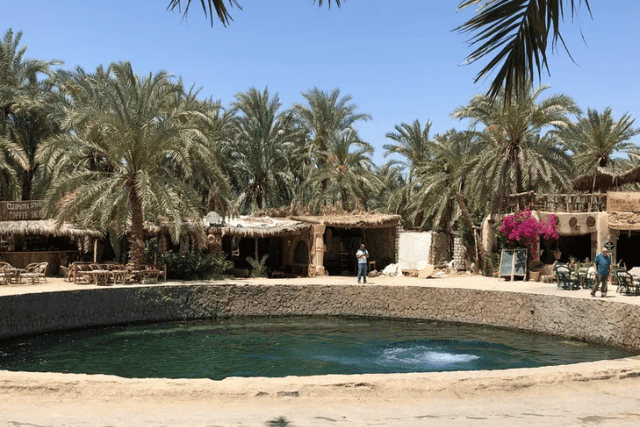
The stone basin that holds the spring today is ancient, though pinning down exactly how ancient is complicated. Archaeologists believe the circular stone structure dates to either the Roman period or the early Islamic era — both of which still makes it somewhere between 1,000 and 2,000 years old. The water pushes up through cracks in the rock and fills the basin with a constant, low gurgling that you can hear before you see the pool. It sounds like the earth is breathing.
What to Expect: Swimming, Mango Juice, and Views
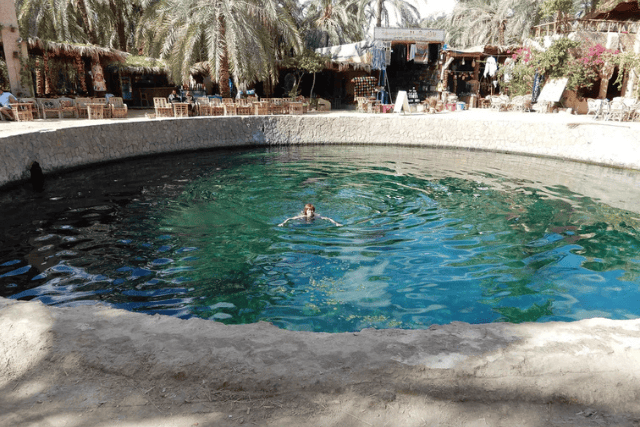
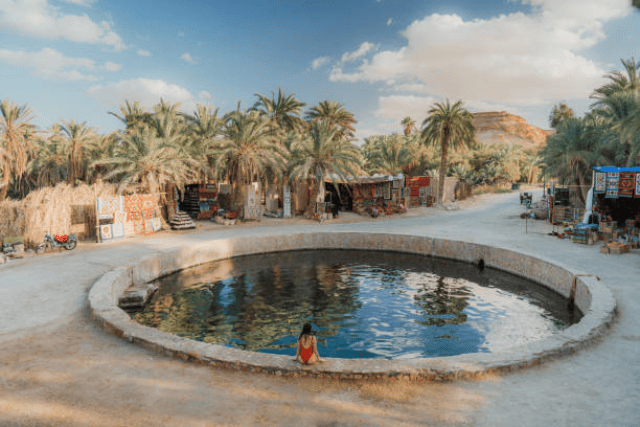
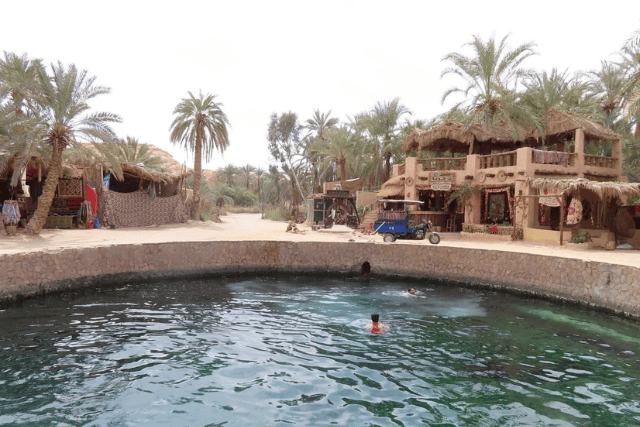
Cleopatra’s Spring is not a manicured attraction. There are no lane ropes, no lifeguards, no tiled changing rooms. What you get instead is a circular stone pool about six meters in diameter, filled with water so clear you can see every crack and crevice in the rock below the surface. The depth varies — roughly chest-height in the center — and the water maintains a steady 29°C to 30°C throughout the year. In the middle of a Siwan summer, when the air temperature can push past 40°C, slipping into the spring feels like stepping into a different world entirely.
The pool is fed continuously by artesian pressure from deep underground, which means the water is always moving, always fresh. It does not stagnate. The overflow runs down into the surrounding palm groves, feeding the agricultural land the oasis depends on. You are, in a very literal sense, swimming in the same water source that has kept this patch of desert alive for millennia.
Sitting just outside the spring, a handful of small, open-air cafes serve what locals will tell you is the essential Siwa experience: a glass of fresh mango juice. Siwa’s mangoes are famously sweet, ripened slowly in the desert heat, and the juice pressed from them — thick, rich, almost syrupy — has nothing in common with anything sold in a carton anywhere else. After a swim in Cleopatra’s Bath, sitting under a palm with a cold glass in hand while the afternoon light turns everything golden, you will understand why travelers remember this moment more vividly than any museum they have visited.
The small shops around the spring also sell handmade Siwan goods — embroidered textiles in the geometric patterns the oasis is known for, silver jewelry set with coral and turquoise, dried herbs and spices used in traditional Siwan cooking. None of it is aggressive. Nobody is going to follow you around or block your path. The commercial activity around Cleopatra’s Spring has a relaxed, take-it-or-leave-it quality that reflects how the whole oasis operates.
Logistics: How to Get to Siwa and the Spring?
Let’s be straightforward about the journey: Siwa is not easy to reach, and that is part of the deal. The oasis sits roughly 750 to 800 kilometers west of Cairo, close to the Libyan border, in a depression in the Western Desert. The road, now substantially improved, still takes 8 to 12 hours to drive depending on your starting point and whether you are in a private 4×4 or on a public bus. There are regular buses departing from Cairo’s Turgoman Station, and the journey, while long, passes through some genuinely dramatic desert scenery.
If time is the constraint, there is a faster alternative: fly into Marsa Matruh on the Mediterranean coast, a route served by EgyptAir from Cairo in under an hour, and then take a 3-hour bus or shared minivan south along the desert road into the oasis. This cuts the total travel time significantly without requiring you to drive the full Cairo-to-Siwa stretch.
Once you are in Siwa itself, the best way to move around is by bicycle. The oasis is flat, the roads between palm groves are quiet, and cycling gives you the pace and freedom to stop whenever something catches your eye — which will be often. Bicycles rent for very little from most guesthouses. If cycling is not your preference, tuk-tuks are everywhere and a local tour that includes Cleopatra’s Spring typically costs around 200 Egyptian pounds, which also gets you several other stops around the oasis.
The spring itself is 3 kilometers from the town center — a comfortable fifteen-minute bike ride or a short tuk-tuk hop. There are no gates, no ticket booths, and no opening hours. You can visit at 6 in the morning before the heat builds, or after dark when the palms are lit silver by the moon.
Cultural Intelligence: Do’s and Don’ts
Siwa is noticeably more conservative than Cairo, Alexandria, or any Red Sea resort. The Siwan people have their own distinct language, customs, and social codes that predate the Arab conquest of Egypt by centuries. Visitors are welcomed warmly, but a basic level of cultural awareness goes a long way.
- Dress modestly in public spaces. Both men and women should cover their shoulders and knees outside of the spring itself. Swimwear is acceptable while in the water at Ain Juba, but change before wandering into the town or the palm groves.
- Carry cash. Siwa has very limited ATM access, and most small businesses, guesthouses, and shops operate on Egyptian pounds in cash only. Withdraw what you need before leaving Cairo or Marsa Matruh.
- Do not use soap or shampoo in the spring. The pool is a living natural water source, not a bathing facility in the municipal sense. The local ecosystem and the communities downstream depend on it. Rinse off separately.
- Drink bottled water only. The tap water in Siwa is saline and not suitable for drinking. Bottled water is widely available and cheap throughout the oasis.
- Ask before photographing people, especially women. Siwans are generally hospitable to travelers, but photography of local women in particular is considered intrusive. Point your camera at the palms, the water, and the ruins instead.
The ‘Siwa Circuit’: Nearby Must-See Attractions
Cleopatra’s Spring is the anchor, but Siwa Oasis rewards those who linger. The following are the places that round out the experience and make the long journey here feel not just worthwhile, but transformative.
The Salt Lakes:
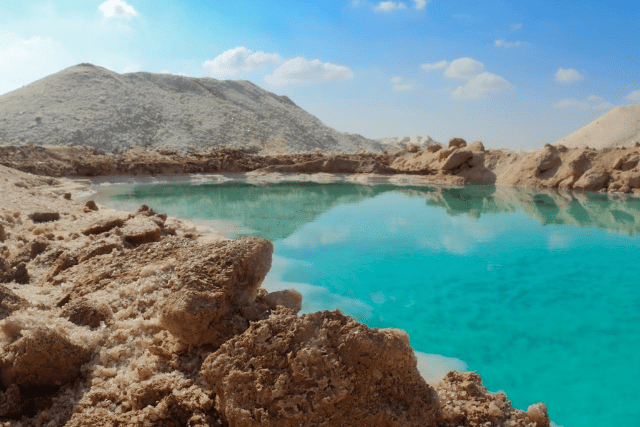
Siwa sits in a depression surrounded by a series of salt lakes that shimmer electric blue and turquoise in the afternoon light. The mineral concentration in the water is high enough that you float effortlessly, much like the Dead Sea. The sensation of lying back in the water with the desert stretching out on all sides, completely still, is one of those rare travel moments that bypasses the usual mental commentary and drops you straight into the present.
Shali Fortress
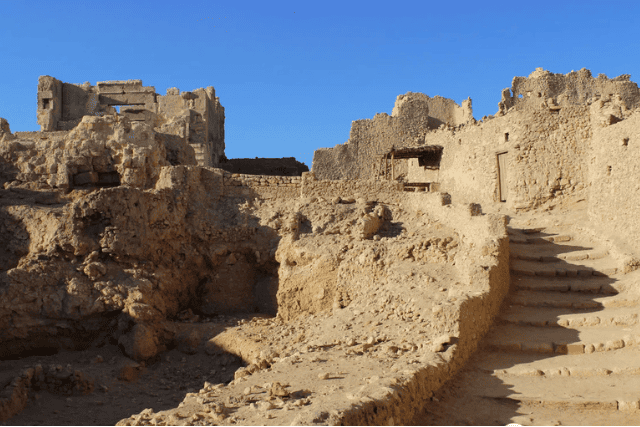
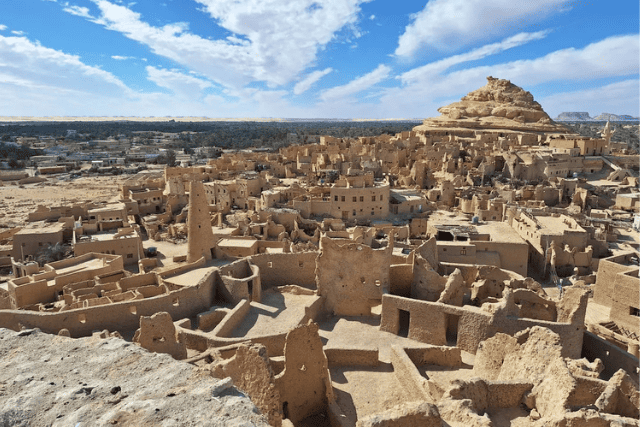
Rising above the town center, the 13th-century mud-brick ruins of Shali have been slowly dissolving back into the earth since a series of rainstorms in the 1920s accelerated their decline. They glow deep amber and gold at dusk, and wandering their narrow passages — some still partially intact — gives a tangible sense of just how long people have been organizing their lives in this improbable desert location. The views over the oasis from the top are worth every uneven step.
Temple of the Oracle
The Oracle Temple at Aghurmi is where Alexander the Great came in 331 BC to receive the confirmation he needed — that he was not merely a Macedonian king, but a god. The temple is ruined but recognizable, perched on a rocky hill with sweeping views across the oasis. Standing in the remains of the inner sanctuary, it is easy to understand why ancient peoples considered this a place where the boundary between the human and the divine was thinner than usual.
Fatnas Island
A small island in Lake Siwa, reached by a short causeway, Fatnas is the uncontested sunset-watching spot in the oasis. Sit at the small cafe under the palms as the light drains out of the sky and the mountains along the horizon turn purple, with a glass of warm Siwan tea made with desert herbs between your hands. The whole oasis suddenly looks like something that has no business existing, which is exactly the feeling Siwa tends to leave you with.
Frequently Asked Questions
Is it safe to swim in Cleopatra’s Spring?
Yes. The spring is a continuously flowing natural pool fed by a deep underground aquifer, which means the water does not sit still long enough to stagnate. It is clean, clear, and perfectly safe for swimming. As with any outdoor natural pool, you may occasionally encounter floating debris — leaves, insects, the usual desert visitors. This is a natural body of water, not a filtered pool, and that is part of its character.
What is the best time of year to visit Siwa?
October through April is the sweet spot. Daytime temperatures sit around 25°C, the nights are crisp and clear, and the light across the desert is extraordinary. July and August are genuinely brutal — temperatures regularly exceed 45°C, and being outdoors for extended periods requires real planning. If you must visit in summer, arrive early in the morning, retreat between noon and four, and do your exploring at dusk.
Where should I stay in Siwa?
Siwa has a small but genuinely charming accommodation scene built around the local building material: kersheef, a mixture of salt rock and mud that keeps interiors naturally cool. Eco-lodges like Sleep in Siwa and Shali Lodge are built in traditional Siwan style, with palm-thatched roofs, open courtyards, and a quietness that city hotels simply cannot replicate. Book ahead during the October-to-April high season, as good rooms fill up quickly.
Is there an entrance fee for Cleopatra’s Spring?
No entrance fee, no ticket, no turnstile. Ain Juba is an open natural site accessible 24 hours a day, seven days a week. You can walk in, swim, and leave without paying a single pound. The cafes and shops nearby are entirely optional — but skipping the mango juice would be a genuine mistake.
What is the connection between Cleopatra’s Spring and the Cleopatra legend in Egypt?
The connection is primarily legendary rather than historically documented. The story holds that Cleopatra VII traveled through Siwa during one of her journeys and bathed in this spring. Whether she actually did so is unknown — no contemporary record confirms it. What is certain is that the spring was an important site long before and long after her era, used by local Siwan women in traditional pre-wedding rituals and revered as a source of blessing and purity. The legend layers beautifully over the physical reality of the place.
Final Thoughts: Why Cleopatra’s Spring is Worth the Journey
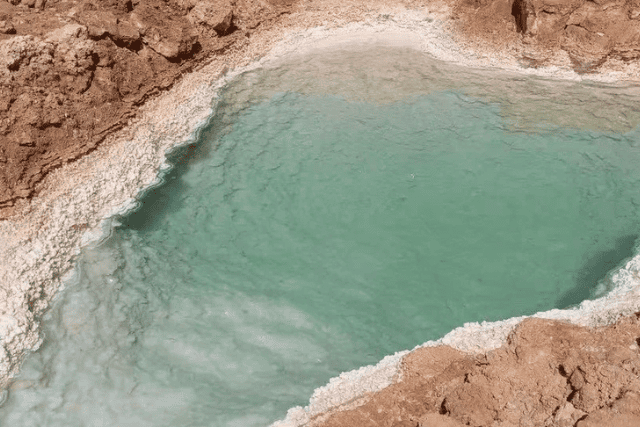
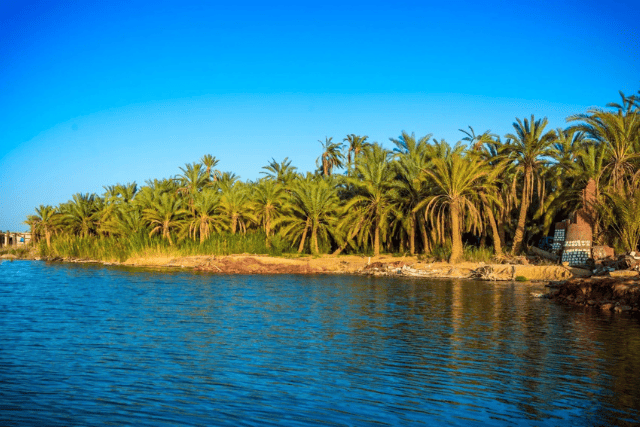
Cleopatra’s Spring does not announce itself. There are no floodlights, no souvenir mega-stores, no tour buses idling in a parking lot. What you find instead is a circular pool of impossibly clear water sitting quietly in a palm grove, doing exactly what it has been doing for a very, very long time. Swimming in it feels less like a tourist activity and more like a conversation with deep time.
Whether Cleopatra bathed here or not almost doesn’t matter. What matters is that the water is real, the history layered around this corner of the Western Desert is genuinely staggering, and the experience of arriving in Siwa — after the long road, through the endless flat desert, into this green impossible oasis — resets something in you. Cleopatra’s Spring is the heart of it. Go swim in it.