
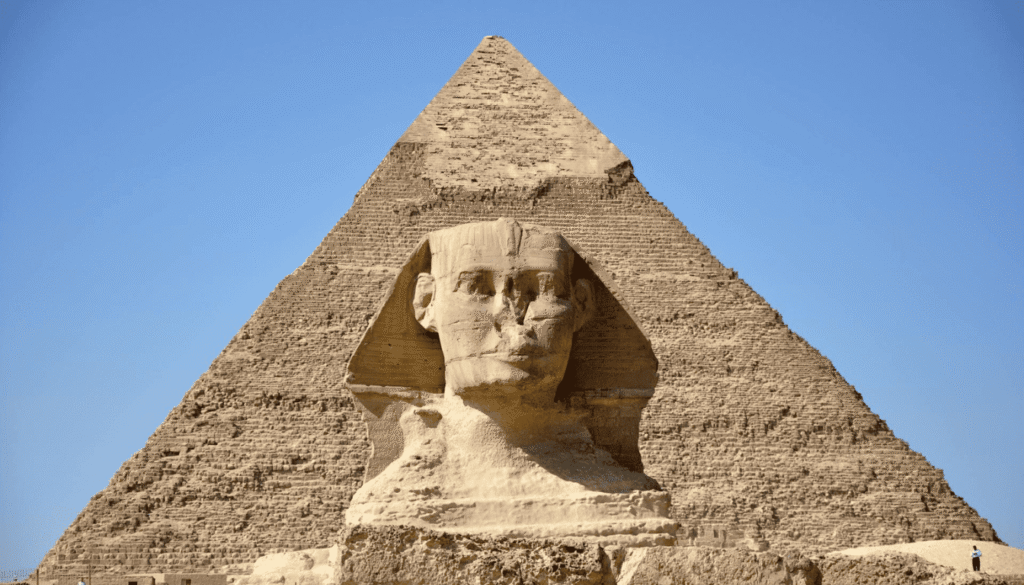
Why Egypt Remains the Ultimate Destination for History Lovers?
When you visit Egypt, you step into a world of legendary historicals sites shaped by thousands of years of civilization. These iconic places reflect Egypt’s rich culture and attract travelers seeking history, meaning, and beauty. Exploring Egypt’s most famous landmarks offers a deep connection to ancient traditions and timeless stories that continue to inspire visitors worldwide.
Picture this: you’re standing at the foot of a 4,500-year-old pyramid, the morning sun casting golden shadows across ancient limestone blocks, and you can’t help but wonder how on earth they built this without modern machinery. That’s the magic of Egypt—a place where history isn’t locked behind glass cases but towers above you, sprawls beneath your feet, and whispers stories from millennia past.
Egypt welcomed over 14.9 million tourists in 2024, marking a remarkable 14% increase from pre-pandemic levels. And honestly? Those numbers make perfect sense. Where else can you explore pharaonic tombs in the morning, dive with sea turtles in the afternoon, and watch the sunset paint desert dunes in shades of amber by evening? This country offers something genuinely rare: a blend of ancient wonders and modern adventures that few destinations can match.
This guide zeroes in on the top 5 historical sites to visit in Egypt that absolutely deserve a spot on your itinerary. We’re not talking about generic tourist traps—these are the places that made me rethink what I thought I knew about human achievement and ingenuity. Whether you’re a first-timer trying to figure out where to start or a returning visitor looking to dig deeper, these ancient Egypt attractions represent the absolute best of what this extraordinary country offers.
“Tap here and know more about Shopping Tourism in Egypt: Where to Find the Best Deals.”
1. The Giza Pyramid Complex: Where It All Begins
Let’s be honest—you can’t visit Egypt without seeing the Pyramids. It would be like going to Paris and skipping the Eiffel Tower, except these structures are roughly 4,000 years older and infinitely more mysterious. The Giza Plateau remains one of the most iconic historical sites in Egypt, and for good reason.
The Great Pyramid and Its Companions
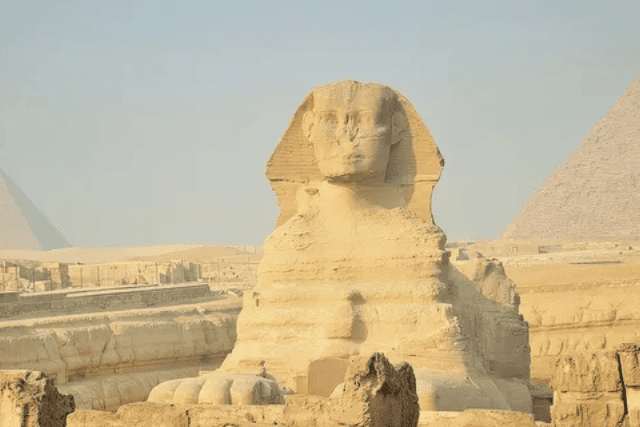
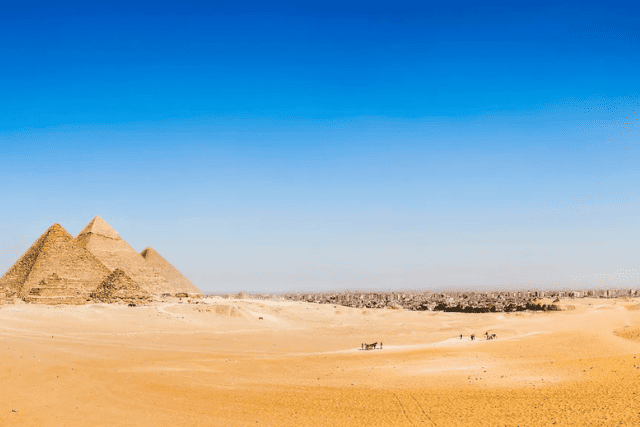
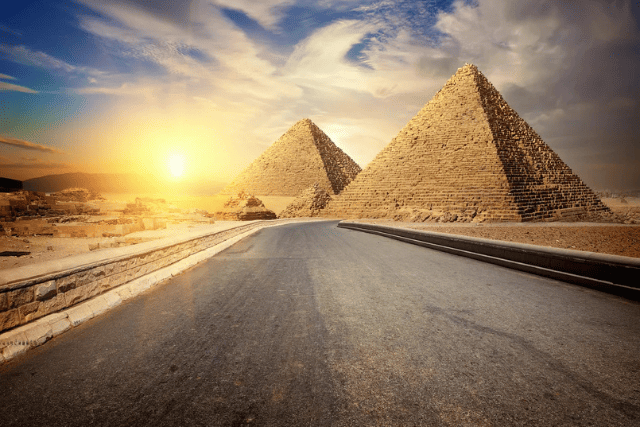
The Great Pyramid of Khufu is the last surviving wonder of the ancient world, and standing next to it genuinely scrambles your sense of scale. Built from roughly 2.3 million stone blocks, each weighing between 2.5 and 15 tons, this architectural marvel held the title of the world’s tallest man-made structure for nearly 4,000 years. Think about that for a second—4,000 years of being unmatched.
The complex includes three main pyramids: Khufu’s (the largest), Khafre’s (which appears taller due to its elevated position), and Menkaure’s (the smallest but still impressively massive). Then there’s the Sphinx, that enigmatic limestone guardian with a lion’s body and a pharaoh’s head, weathered by millennia but still watching over the plateau with an inscrutable expression.
Here’s my hard-won advice: book a sunrise tour. I made the mistake of arriving around 10 AM during my first visit, and between the scorching heat and the waves of tour buses, the experience felt more overwhelming than awe-inspiring. Sunrise tours start early—we’re talking 5 AM pickup early—but you’ll witness something magical. The pyramids emerge from the dawn mist, bathed in soft pink and gold light, with only a handful of other visitors around. The temperature is manageable, the light is perfect for photography, and you can actually hear yourself think. Trust me on this one.
“All inclusive Trip Giza pyramids, Sphinx,Camel Ride,Lunch,Bike.”
The Grand Egyptian Museum: History’s New Home
After years of anticipation and delays, the Grand Egyptian Museum (GEM) has finally opened its doors near the Giza Plateau. This isn’t just another museum—it’s the world’s largest archaeological museum, housing over 100,000 artifacts, including the complete collection from Tutankhamun’s tomb displayed together for the first time.
The museum’s design alone is worth the visit. Its massive glass facade offers stunning views of the pyramids, creating this surreal moment where you’re looking at ancient artifacts with their 4,500-year-old inspirations visible through the windows. The conservation labs are partially visible to visitors, so you can watch restoration experts at work. It’s like getting a backstage pass to history.
“Tap here and know more about the Grand Egyptian Museum: The New Gateway to Ancient Egypt 2025.”
Beyond Giza: Alternative Pyramid Sites
If the crowds at Giza feel overwhelming (and sometimes they absolutely do), consider these alternatives that showcase Egypt’s pyramid evolution:
Saqqara: Home to the Step Pyramid of Djoser, this is where pyramid construction began. It’s cruder than its Giza cousins but fascinating precisely because you can see the experimentation. The surrounding necropolis contains dozens of tombs with remarkably well-preserved reliefs and hieroglyphs. On a typical day, you might have entire tomb chambers to yourself—a rare luxury among Egyptian historical sites.
Dahshur: This site features the Bent Pyramid and the Red Pyramid, both built by Pharaoh Sneferu (Khufu’s father). The Bent Pyramid is particularly intriguing because you can see where the builders changed the angle mid-construction—apparently, they got nervous about structural integrity. Unlike Giza, Dahshur feels almost forgotten, with sparse crowds and a peaceful atmosphere that lets you absorb the magnitude of these structures.
2. The Valley of the Kings: Sleeping with Pharaohs
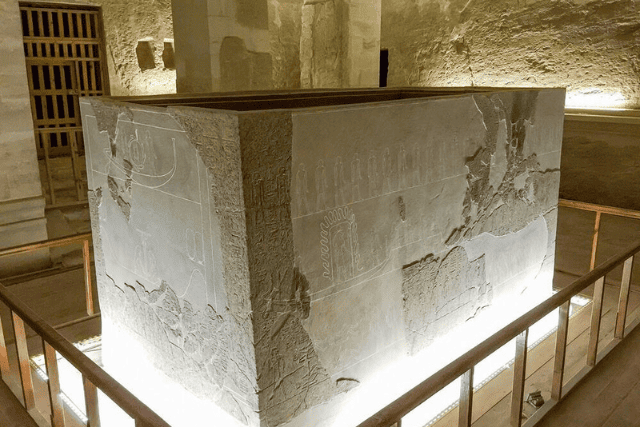
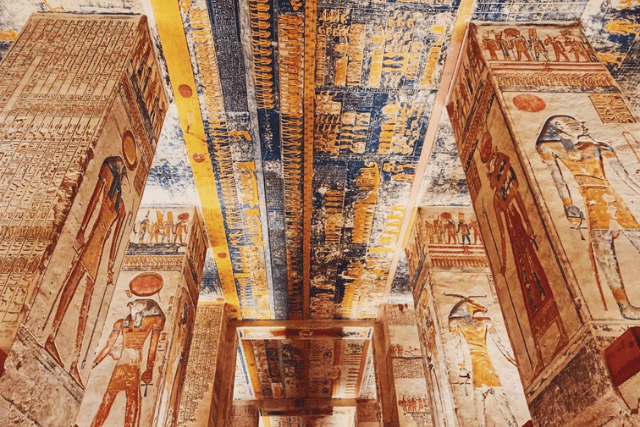
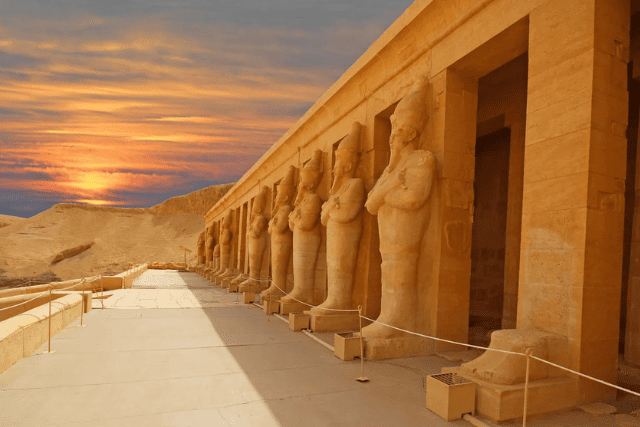
If the pyramids represent ancient Egypt’s beginning, the Valley of the Kings showcases its golden age. Located on Luxor’s West Bank, this necropolis served as the final resting place for New Kingdom pharaohs, including the most famous tomb discovery of all time—Tutankhamun’s.
A Desert Filled with Royal Secrets
Carved into the limestone hills across the Nile from modern Luxor, the Valley contains 63 discovered tombs, though only a handful are open to visitors at any given time. The ancient Egyptians chose this location deliberately—the pyramid-shaped mountain peak called Al-Qurn towered above, a natural pyramid standing guard over their buried kings.
The tombs here differ dramatically from the pyramids. Instead of reaching toward the sky, these burials tunnel deep into the earth, with corridors descending hundreds of feet into the bedrock. The walls explode with color—deep blues, vibrant yellows, rich reds—depicting the pharaoh’s journey through the underworld. After 3,000 years underground, the preservation quality will make your jaw drop.
Must-See Tombs
Your entrance ticket includes access to three standard tombs, and choosing which ones to visit can feel overwhelming. Here’s my take:
KV62 (Tutankhamun): Yes, it’s small. Yes, Howard Carter already removed most of the treasures (now in Cairo’s Egyptian Museum and the GEM). But there’s something profound about standing in the actual place where that famous golden mask rested for over 3,000 years. Tut’s mummy remains in the tomb, visible in a climate-controlled case—the only pharaoh still residing in his original resting place. Note that this tomb requires an additional ticket beyond your standard admission.
KV9 (Ramses VI): If I could only recommend one tomb, this would be it. The astronomical ceiling is absolutely mind-blowing, covered in detailed depictions of the night sky, constellations, and religious texts. The colors remain vivid, and the sheer artistry on display rivals anything in the Renaissance. Fair warning: this tomb gets crowded because it’s that spectacular.
KV17 (Seti I): This is the deepest tomb in the valley, stretching over 400 feet into the mountain. The reliefs are incredibly detailed and well-preserved. However, it’s often closed for conservation work, so check ahead if you’re specifically hoping to visit.
Conservation Challenges
Here’s something most visitors don’t realize: our breath damages these tombs. Every person who enters brings humidity, raising moisture levels that promote salt crystallization and damage the ancient pigments. The carbon dioxide we exhale alters the atmospheric chemistry inside these sealed chambers. This is why some tombs, like the spectacular tomb of Nefertari, severely restrict visitor access—they’re trying to preserve these treasures for future generations.
When you visit, resist the temptation to touch the walls. I’ve seen people lean against reliefs for photos, and it makes conservators cry. These paintings survived three millennia in sealed darkness but deteriorate rapidly under modern tourism pressures.
3. Karnak Temple Complex: Walking Among Gods
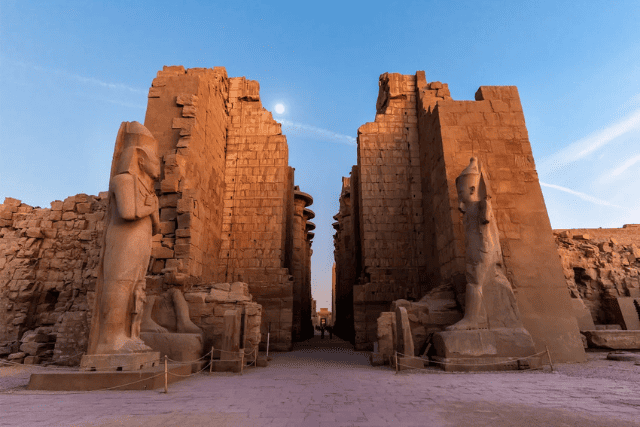
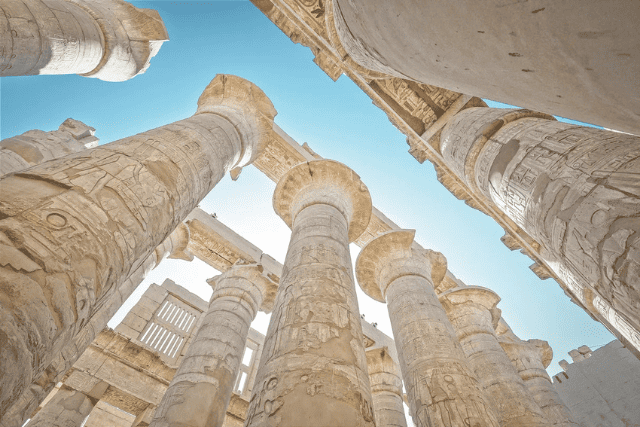
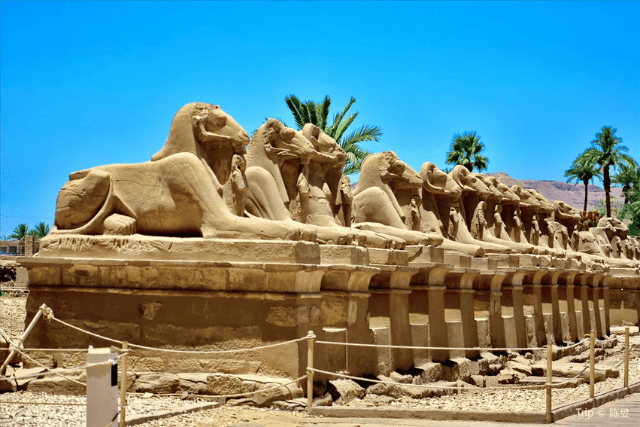
Still in Luxor (this city is absolutely packed with treasures), the Karnak Temple Complex represents Egypt’s most ambitious religious construction project. Built over 2,000 years by successive pharaohs, each trying to outdo their predecessors, Karnak evolved into the largest religious complex ever built—anywhere, ever.
A City of Temples
Karnak isn’t just one temple but rather a vast complex covering over 200 acres. The Precinct of Amun-Re forms the heart of the site, dedicated to Thebes’ chief deity. Walking through the massive pylons (ceremonial gateways) is like stepping through portals in time, each one leading deeper into Egypt’s religious heart.
The Hypostyle Hall steals the show—and when I say steals, I mean it completely dominates your attention. This forest of columns covers 54,000 square feet and features 134 massive columns arranged in 16 rows. The 12 central columns soar 69 feet high, and their capitals (the decorated tops) are large enough to hold 50 standing people. The scale is genuinely difficult to comprehend until you’re standing there, craning your neck upward, trying to take it all in.
Every surface is covered with reliefs and hieroglyphs. Battle scenes showing pharaohs smiting enemies, religious processions, offerings to gods—it’s an encyclopedia of ancient Egyptian civilization carved in stone. Early morning or late afternoon light streaming through the columns creates dramatic shadows and highlights that photographers dream about.
Sacred Spaces and Ancient Rituals
The Sacred Lake, a rectangular pool where priests performed ritual purifications, still holds water today. Sitting beside it offers a rare moment of peace in an otherwise overwhelming site. You can imagine priests performing dawn ceremonies, the water reflecting the temple’s massive forms.
One of my favorite details? The Scarab Statue near the Sacred Lake. Local tradition claims that walking around it seven times counterclockwise brings good luck. Sure, it’s probably nonsense, but watching visitors from around the world participate in this modern ritual around an ancient symbol is oddly touching. History keeps evolving, adding new layers even to 3,000-year-old stones.
Practical Tips for Karnak
This site is enormous, and the Egyptian sun is merciless. Bring water, wear comfortable shoes (you’ll walk several miles), and consider hiring a guide. The difference between wandering randomly and having someone explain what you’re looking at is night and day. A knowledgeable guide can point out details you’d otherwise miss and bring the stories carved in stone to life.
Avoid midday if possible—the combination of heat and crowds peaks between 11 AM and 2 PM. Early morning visits (the complex opens at 6 AM) offer cooler temperatures and better light. The complex also opens for night visits with dramatic lighting, though you’ll miss the detailed colors visible in natural light.
4. Abu Simbel: Ramses II’s Desert Masterpiece
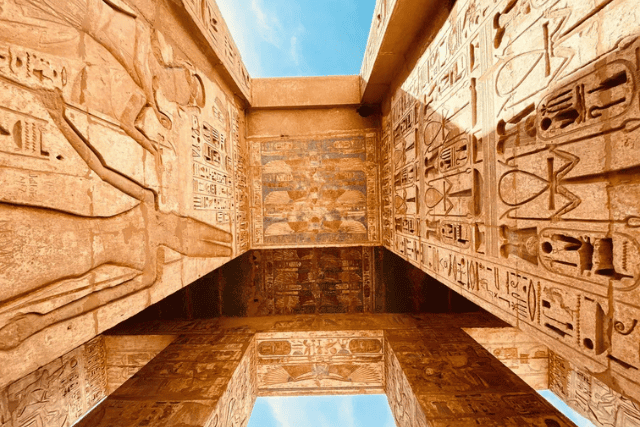
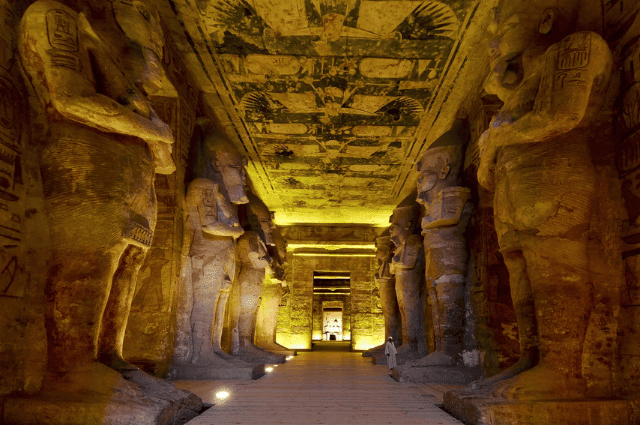
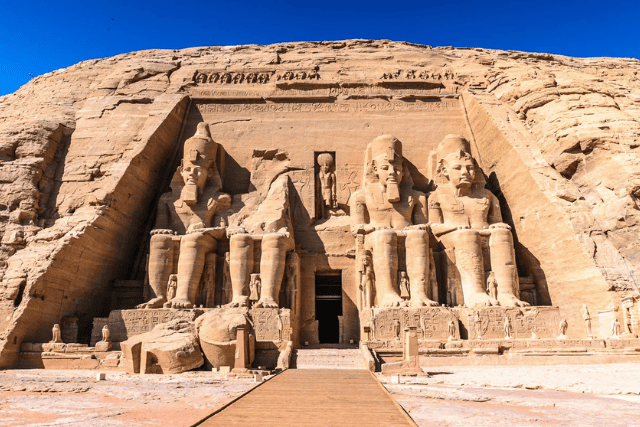
Sitting about 230 kilometers south of Aswan, near Sudan’s border, Abu Simbel represents ancient Egypt’s most ambitious flex—a massive temple complex carved directly into a mountainside, designed to intimidate Nubia into submission and glorify Pharaoh Ramses II for eternity.
Four Colossi in the Desert
The approach to the Great Temple is unforgettable. Four massive seated statues of Ramses II, each 67 feet tall, dominate the facade. The pharaoh gazes out over what was once enemy territory, an eternal reminder of Egypt’s power. These aren’t freestanding statues—they’re carved from the living rock of the mountain itself.
The temple’s interior extends 200 feet into the mountain, with walls covered in reliefs depicting Ramses’s military victories (particularly his campaign against the Hittites at the Battle of Kadesh, which he depicted as a great triumph despite it being more of a draw). The inner sanctuary contains statues of Ramses alongside the gods Ptah, Amun-Re, and Re-Horakhty.
Here’s the truly amazing part: twice a year (around February 22 and October 22), sunlight penetrates the entire depth of the temple to illuminate the sanctuary statues. This solar alignment was deliberately engineered 3,200 years ago, demonstrating the ancient Egyptians’ sophisticated astronomical knowledge.
A Temple Saved from Drowning
Abu Simbel has a dramatic modern chapter. When Egypt built the Aswan High Dam in the 1960s, the resulting Lake Nasser threatened to submerge these temples forever. In an unprecedented international effort coordinated by UNESCO, engineers cut the entire temple complex into massive blocks, moved them 200 feet higher, and reassembled them with such precision that the seams are barely visible.
This engineering feat cost $40 million in 1960s money and took four years to complete. Workers carved the temples into 1,036 blocks (some weighing 30 tons) and pieced them back together like the world’s most expensive jigsaw puzzle. The artificial mountain they created even includes a concrete dome structure inside to support the relocated temples—invisible to visitors but crucial to the site’s preservation.
Getting There
Abu Simbel’s remote location presents logistical challenges. Most visitors fly from Aswan (a 45-minute flight) or join an early morning convoy of buses that departs around 4 AM (it’s a three-hour drive each way). The convoy system exists due to security concerns in the region.
Day trips feel rushed but doable—you’ll have about two hours at the site, enough to explore both temples thoroughly but not linger. Some Nile cruises include Abu Simbel, either by backtracking from Aswan or by flying guests there while the ship repositions. Given the site’s significance as one of the most impressive ancient Egypt attractions, the early wake-up call is absolutely worth it.
“Full Day Tour to Abu Simbel Temples from Aswan.”
5. Philae Temple: Island Sanctuary of Isis
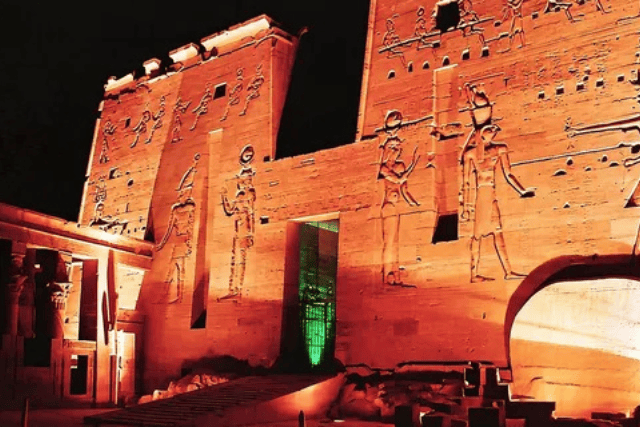
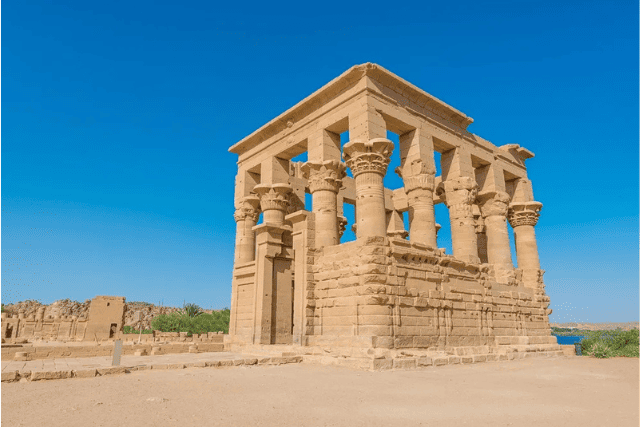
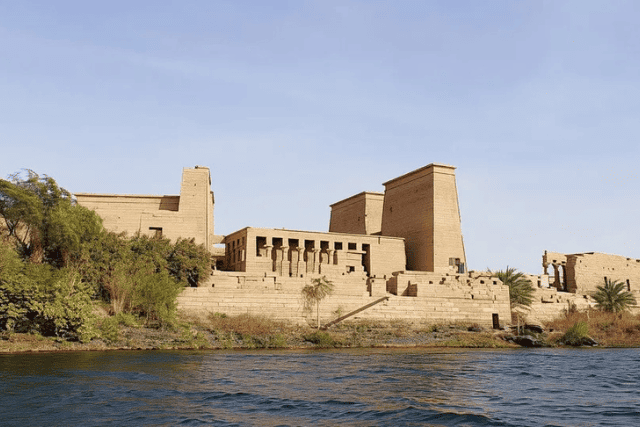
Located on an island near Aswan, Philae Temple dedicated to the goddess Isis represents ancient Egypt’s final chapter. This sacred complex remained active long after Egypt’s conversion to Christianity, finally closing around 550 AD—making it one of the last functioning temples of the ancient Egyptian religion.
A Temple That Moved
Like Abu Simbel, Philae has a dramatic modern survival story. The original temple stood on Philae Island, but the first Aswan Dam’s construction in 1902 partially submerged it for much of each year. When the High Dam was built in the 1960s, complete submersion became inevitable.
Between 1972 and 1980, UNESCO orchestrated another rescue operation. Engineers built a coffer dam around Philae Island, pumped out the water, dismantled the entire temple complex stone by numbered stone, and rebuilt it on nearby Agilkia Island—which was even landscaped to match the original island’s topography. The attention to detail was extraordinary; they recreated the exact orientation and setting to preserve the temple’s spiritual character.
Beauty and Mythology
Philae is gorgeous. The island setting creates a serene atmosphere, and the temple’s design showcases the Greco-Roman period’s architectural style—slightly different from the massive, imposing structures of earlier dynasties. The reliefs are remarkably well-preserved, depicting Isis’s mythological story, particularly the death and resurrection of her husband Osiris and the birth of their son Horus.
The Birth House (Mammisi) is particularly interesting, covered with reliefs showing Isis nursing the infant Horus. These scenes held deep religious significance—pharaohs claimed descent from Horus, so depicting this divine birth legitimized royal power.
Unlike the crowds at Luxor or Giza, Philae often feels peaceful. You’ll reach it by motorboat from the marina—a short, pleasant ride across the reservoir’s blue waters. The approach by boat adds to the experience; ancient pilgrims also arrived by water, and there’s something timeless about that method of arrival.
Sound and Light Show
Philae hosts an evening sound and light show that’s actually worth considering (I usually skip these tourist productions, but this one works). The temple’s island setting and dramatic lighting create genuinely beautiful moments, and the narration, while occasionally cheesy, does a decent job explaining the site’s history and the Isis/Osiris mythology. Shows run in multiple languages, so check the schedule.
The temple complex opens until 4 PM for regular visits, but you’ll need to book the sound and light show separately if you’re interested. Evening visits mean cooler temperatures—a significant plus in Aswan’s climate.
“Tap here and enjoy with Sound and Light Show experience at Philae Temple from Aswan, Book now.”
Planning Your Egyptian Historical Adventure
Choosing Your Priorities
Egypt overflows with historical places in Egypt, and trying to see everything in one trip is a recipe for exhaustion. Here’s my honest advice: quality beats quantity every time. I’d rather spend a full day at Karnak, really absorbing the atmosphere and details, than rush through five sites checking boxes.
For first-timers focused on ancient history, the “Big Three” cities approach works brilliantly:
Cairo gives you the pyramids, the Sphinx, and the Grand Egyptian Museum—basically Egypt’s greatest hits. Plan three to four days here, including day trips to Saqqara and Dahshur if you’re pyramid-obsessed (and who isn’t?).
Luxor deserves at least two full days—one for the East Bank (Karnak and Luxor temples) and one for the West Bank (Valley of the Kings, Hatshepsut’s Temple, and the Colossi of Memnon). Honestly, you could spend a week here and still want more time.
Aswan offers Philae Temple and serves as the departure point for Abu Simbel. Two days lets you see the main attractions without rushing. The city’s laid-back vibe makes it a nice breather after Cairo’s intensity.
The Nile Cruise Option
A Nile cruise between Luxor and Aswan (or vice versa) is touristy as hell, but it’s touristy for good reasons. The cruise ships stop at temples along the river—Kom Ombo and Edfu—that are harder to reach independently. The journey itself is magical, watching rural Egyptian life unfold along the riverbanks while you float past.
Cruises typically run three to four nights and handle all the logistics. You’ll eat well, sleep comfortably, and wake up at new temples without dealing with transportation hassles. For visiting Egypt’s top historical attractions efficiently, it’s hard to beat.
“Discover unforgettable Nile cruises and coastal escapes.”
Bringing the Stones to Life
These five sites — the Pyramids of Giza, the Valley of the Kings, Karnak Temple, Abu Simbel, and Philae Temple—represent the absolute pinnacle of what ancient Egyptian civilization achieved. They’re not just tourist attractions; they’re portals to a world where pharaohs claimed godhood, priests wielded enormous power, and artists created works meant to last for eternity.
What makes these places genuinely special isn’t just their age or scale, though both are staggering. It’s the tangible connection they offer to people who lived thousands of years ago but shared the same human desires for meaning, legacy, and transcendence. Standing in a tomb painted 3,200 years ago, you’re looking at colors mixed by hand, brushstrokes applied by an artisan whose name we’ll never know, creating beauty that outlasted their entire civilization.
Egypt rewards curiosity and punishes schedules. Yes, you should plan. Yes, you should book tickets in advance for the Grand Egyptian Museum or restricted tombs. But also leave room for spontaneity—for lingering in a temple courtyard as sunset turns the stone golden, for accepting tea from a Nubian family, for watching the Nile flow past exactly as it did when these temples were new.
every traveler I’ve met who actually went to Egypt says the same thing: they’d do it again in a heartbeat. These ancient attractions deliver experiences that photographs and documentaries simply cannot capture. You need to stand there, crane your neck up at massive columns, feel the desert heat radiating off limestone blocks, and let the sheer audacity of what you’re looking at sink in.
So book that flight Hire good guides. Pack sunscreen and comfortable shoes. Egypt’s historical treasures aren’t going anywhere—they’ve survived millennia and will survive longer. But your opportunity to see them with your own eyes, to walk where pharaohs walked, to stand in spaces designed to awe and inspire? That chance exists right now, waiting for you to take it.
Trust me—these stones have stories to tell, and they’re worth listening to.
What Makes Discover Egypt Now Your Ultimate Travel Companion?
Pingback: Top 5 Beaches in Egypt You Must Visit: Why Travelers Love Them - Discover Egypt Now