
A Phoenix Rising from the Ashes
The Bibliotheca Alexandrina stands as one of Egypt’s most inspiring cultural landmarks and a modern revival of the ancient Library of Alexandria. If you’re planning to visit-bibliotheca-alexandrina, you’ll discover a unique blend of knowledge, architecture, and history. Here are the best reasons why this iconic library deserves a place on your Alexandria itinerary.
When you think of Egypt, your mind probably jumps straight to the pyramids of Giza or the temples of Luxor. And sure, those are absolutely worth the trip. But here’s something most travelers miss: Alexandria isn’t just another stop on the tourist trail. This coastal city holds something far more intimate and profound—a conversation across millennia about what it means to preserve human knowledge.
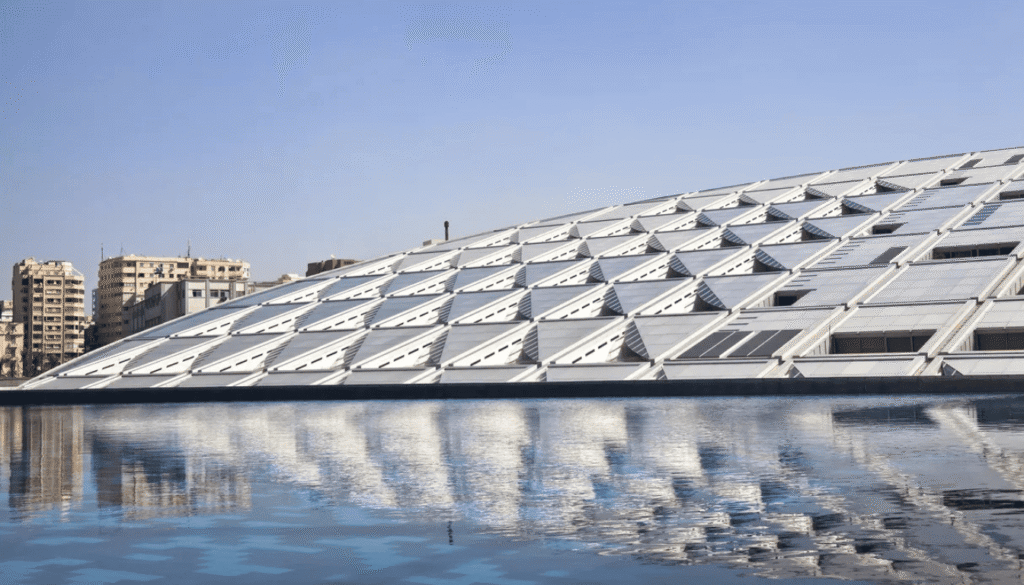
The Bibliotheca Alexandrina stands today as a phoenix rising from the ashes of lost wisdom. When it opened its doors in 2002, it didn’t just become another library. It became a 220-million-dollar promise to the world that Alexandria—once home to the greatest center of learning in the ancient world—was ready to reclaim its intellectual crown. The building itself is a work of art, a massive sun disc emerging from the Mediterranean, designed by Norwegian architects Snøhetta to bridge 3,000 years of history in glass, granite, and light.
But why should you visit? What makes this modern library worth adding to your Egypt itinerary? Let me break down the five reasons that make the Bibliotheca Alexandrina not just a cultural attraction in Alexandria, but an experience that will change how you think about knowledge, memory, and what we owe to future generations. Quick Summary: Inaugurated in 2002, the Bibliotheca Alexandrina is a $220 million cultural hub designed by Snøhetta to revive the spirit of the ancient world’s greatest center of learning.
1. Walking Through a Legend Reborn
The original Library of Alexandria wasn’t just a building—it was an obsession. Founded around 285 BCE by Ptolemy I Soter, the library had one audacious mission: to collect every piece of human knowledge in existence. Scholars would literally seize scrolls from ships docking in Alexandria’s harbor, make copies, and return the copies while keeping the originals. That’s how serious they were.
Then came the tragedy. Fires, wars, political chaos—the Library of Alexandria met its end not in one dramatic blaze but through centuries of neglect and destruction. Some blame Julius Caesar’s naval battle in 48 BCE. Others point to later conquests. The truth is messier and sadder: the library faded away, taking with it works we’ll never read, discoveries we’ll never know about, entire schools of thought lost to time.
For nearly two thousand years, that loss became an impossible myth, a symbol of everything humanity could achieve and everything we could lose. Then in 1974, something remarkable happened. Egypt, with UNESCO’s backing, decided to dream again. The vision was clear: rebuild not just a library, but a lighthouse of ancient knowledge for the modern world.
When you visit the Library of Alexandria modern incarnation, you’re not just seeing a building. You’re stepping into a promise kept, a dream realized across centuries. The weight of that history is palpable the moment you approach the structure. This is why the Bibliotheca Alexandrina matters—it’s proof that some dreams refuse to die, no matter how many centuries pass.
2. An Architectural Marvel That Takes Your Breath Away
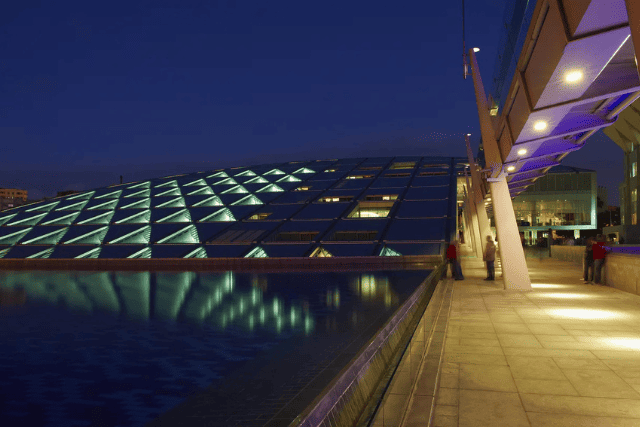
Let’s talk about what you’ll actually see when you arrive. The Bibliotheca Alexandrina doesn’t look like any library you’ve visited before. The Norwegian firm Snøhetta won an international competition with a design so bold it borders on the mystical: a tilted cylinder that resembles a solar disc rising from the sea—Ra’s sun, reborn on the Mediterranean coast.
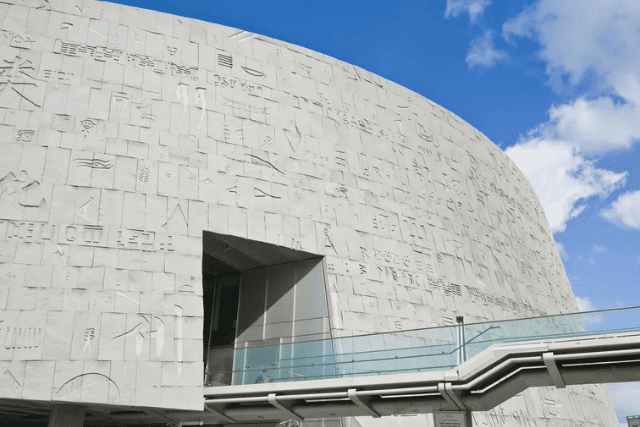
The exterior walls alone are worth the trip. Made from gray Aswan granite, they’re carved with characters from 120 different human scripts. You’ll see Egyptian hieroglyphics next to Chinese characters, Arabic calligraphy beside ancient Greek, musical notations intertwined with mathematical symbols. It’s a love letter to human literacy itself, a reminder that knowledge has always crossed borders and languages. Stand close to these walls, run your hand over the carved symbols, and you’re literally touching a celebration of every culture that ever put thought to page.
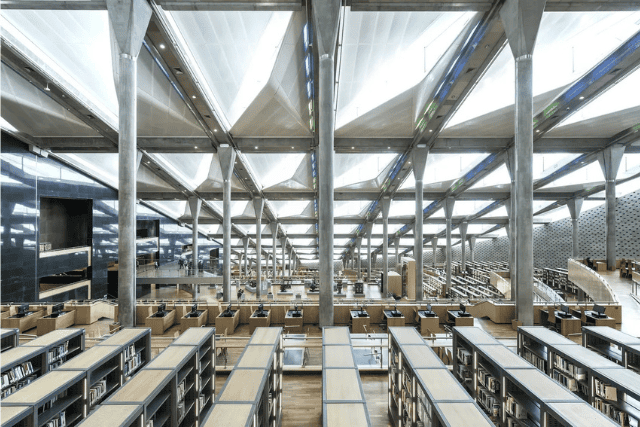
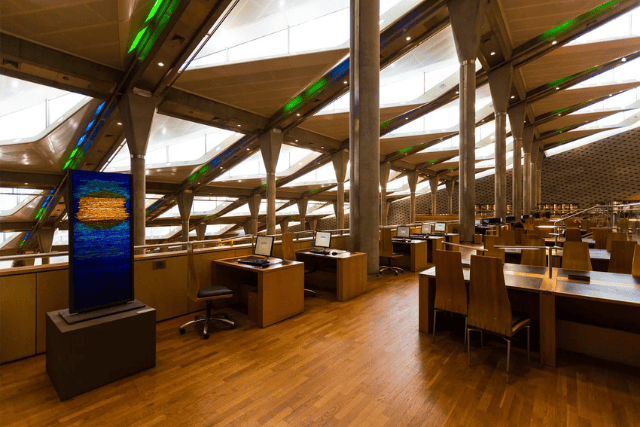
But the real magic happens when you step inside. The glass roof is tilted toward the sea, perforated with thousands of fiber-optic points that look like stars scattered across the ceiling. Natural light floods the reading halls below, but the design filters out harmful UV rays, protecting the books while creating an atmosphere that feels almost sacred. On sunny days, the light moves across the terraced floors like something alive, constantly shifting, never the same twice.
This architectural masterpiece isn’t just pretty to look at—it fundamentally changes your experience of being in a library. The design makes you want to read, to think, to sit quietly and absorb knowledge. That’s no accident. Every angle, every surface, every beam of light is intentional. The building itself teaches you something about how space can inspire thought.
3. It’s Not Just Books—It’s a Universe of Discovery
Here’s where the Bibliotheca Alexandrina really separates itself from any other library experience. Sure, there are millions of books. But thinking of this place as just a library is like calling the pyramids ‘some old buildings.’ The complex is designed as a full-spectrum knowledge center, with spaces and collections tailored to different ages and needs.
The main reading hall is staggering—the largest open reading room in the world. It descends through 11 terraced levels, accommodating between 2,000 and 2,500 readers at once. Walking down those levels feels like descending into the collective mind of humanity. Each level offers different collections, different specializations, different ways of thinking about knowledge. You could spend a week here and never see it all.
But the library goes deeper. There are four specialized libraries within the complex, each serving different communities. The Children’s Library welcomes kids aged 6-11 with interactive exhibits and age-appropriate collections. The Youth Library targets teenagers aged 11-17, that crucial age when reading habits either stick or fade. Most moving of all is the Taha Hussein Library for the blind and visually impaired, named after Egypt’s most famous blind writer. This isn’t tokenism—it’s a full-featured library with braille books, audiobooks, and assistive technology. It declares that knowledge belongs to everyone, without exception.
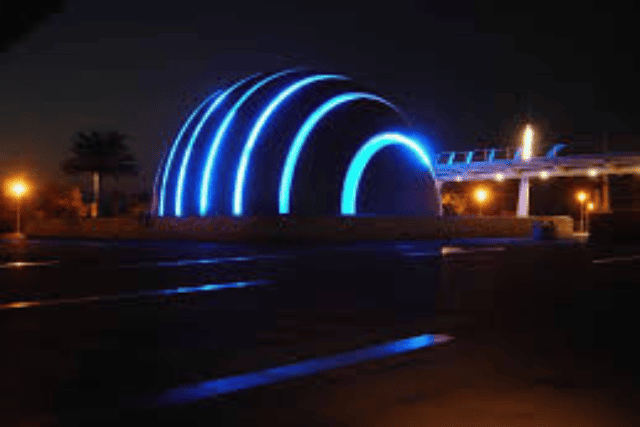
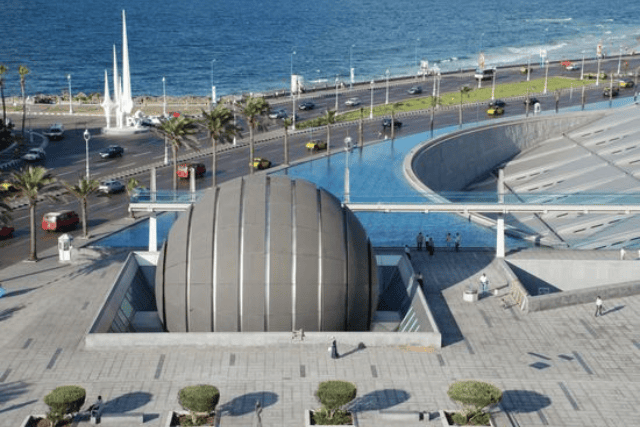
And then there’s the Planetarium Science Center, which locals affectionately call ‘the miniature Death Star’ because of its spherical design. Inside, you can watch 3D films about space exploration and Egyptian history. It’s where ancient astronomy meets modern astrophysics, where Ptolemy’s star charts meet NASA’s telescopes. The planetarium reminds you that Alexandria was always about looking up, asking questions, refusing to accept ‘I don’t know’ as a final answer.
4. Museums That Tell Stories You Won’t Hear Anywhere Else
Within the Bibliotheca Alexandrina complex, you’ll find a collection of museums that punch well above their weight. These aren’t afterthoughts or dusty displays—they’re carefully curated windows into different aspects of Egyptian history and culture, often showcasing artifacts and stories that don’t make it into the typical Cairo museum circuit.
The Antiquities Museum houses relics spanning from the Pharaonic era through the Islamic period. What makes it special are the underwater discoveries recovered from Alexandria’s Mediterranean floor. For centuries, parts of ancient Alexandria—including portions of the famous Pharos lighthouse—have been submerged beneath the waves. Archaeologists have been pulling up incredible finds: statues, pottery, coins, everyday objects that spent two thousand years underwater. Seeing these artifacts is like watching history resurface, literally.
The Manuscript Museum showcases ancient texts and digitized manuscripts that survived history’s many close calls. Some of these documents are so fragile that seeing them in person, even behind glass, feels like a privilege. The digitization efforts here are crucial—they’re creating backups against future disasters, ensuring that even if physical copies deteriorate, the knowledge survives.
Perhaps most poignant is the Sadat Museum, dedicated to Egypt’s late President Anwar Sadat. On display is his blood-stained military uniform from his assassination in 1981, along with personal belongings that humanize a figure often reduced to political legacy. It’s an unexpectedly intimate collection that grounds all the library’s lofty ideals about knowledge in the messy reality of human history.
Don’t miss the Bulaq Press exhibition either. Established in 1820, Bulaq Press was Egypt’s first printing operation, a technological revolution that helped pull the country into the modern age. The preserved printing machines on display are beautiful in their industrial way, each one a reminder that spreading knowledge has always required both vision and engineering.
5. It’s the Perfect Launch Point for Exploring Alexandria
The Bibliotheca Alexandrina sits on the Corniche, Alexandria’s waterfront promenade, making it the ideal starting point for exploring one of the Mediterranean’s most fascinating cities. After spending your morning immersed in books and history, you can easily walk to some of Alexandria’s other cultural attractions.
Just down the coast stands the Qaitbay Citadel, built on the exact spot where the legendary Pharos lighthouse once guided ships home. The lighthouse was one of the Seven Wonders of the Ancient World, and though it’s long gone, the citadel incorporates some of its fallen stones. Walking these ramparts, looking out over the same waters the lighthouse once illuminated, you feel history layering upon itself.
The Catacombs of Kom El Shoqafa offer something entirely different—a labyrinth carved into bedrock, where Egyptian, Greek, and Roman styles merge into something unique. This is Alexandria in architectural form: hybrid, cosmopolitan, impossible to pin down to just one cultural tradition.
For a change of pace, visit Pompey’s Pillar, a 27-meter red granite column that towers over what was once another ancient library site. The pillar reminds you that Alexandria was once dotted with centers of learning, not just the famous main library. Knowledge was everywhere in this city.
If you need a break from history and architecture, the Montaza Palace Gardens offer 150 acres of manicured green space along the coast. It’s where Egyptian royalty once strolled, and now it’s open to everyone. Pack a picnic, watch the sunset over the Mediterranean, and let everything you’ve seen sink in.
The beauty of basing your Alexandria visit around the Bibliotheca Alexandrina is that everything feels connected. The library isn’t isolated from the city’s other treasures—it’s in conversation with them, part of an ongoing dialogue about memory, loss, and preservation that Alexandria has been having with itself for three thousand years.
Practical Logistics: The ‘Know Before You Go’ Playbook
Let’s get down to the practical details, because knowing these logistics will make your visit dramatically smoother.
Tours and Timing: The Bibliotheca Alexandrina offers guided tours every 45 minutes in Arabic, French, and English. These tours are worth taking—the guides are knowledgeable and passionate, and they’ll point out details you’d miss on your own. Budget at least 2-3 hours for a thorough visit, though you could easily spend a full day here if you’re really diving into the museums and collections.
The Ticket Trick: Here’s something that confuses first-time visitors—the ticket office is at the back of the building, not at the main entrance. You’ll need to check all bags at security, but cameras and wallets are allowed through. Don’t panic about being separated from your belongings; the bag check system is efficient and secure.
Dress Code and Etiquette: Egypt is a conservative country, and while Alexandria is more cosmopolitan than many other cities, it’s still respectful to dress modestly. Keep shoulders and knees covered. You’re not going to be turned away for wearing shorts, but you’ll feel more comfortable and get friendlier interactions if you adapt to local norms.
Connectivity: The public WiFi at the library is notoriously patchy. If you need reliable internet access during your trip, grab a local SIM card from Vodafone or Orange at the airport when you arrive. They’re cheap, easy to set up, and will save you endless frustration.
FAQ: Quick Answers for Planning Your Visit
How much did it cost to build the new library?
The Bibliotheca Alexandrina cost approximately $220 million to construct, with funding from the Egyptian government, UNESCO, and international donors. The project took 12 years from groundbreaking to completion, finally opening in 2002.
Can kids visit the Bibliotheca Alexandrina?
Children under 6 years old are not admitted to the main reading hall, primarily because maintaining quiet for the researchers and readers is important. However, the library offers daycare services for young children, and there’s a dedicated Children’s Library for kids aged 6-11 with age-appropriate collections and activities.
Is it a day trip from Cairo?
Absolutely. Alexandria is roughly 2-3 hours from Cairo by either car or train, making it a very doable day trip. That said, if you can swing an overnight stay, you’ll be able to explore the city more thoroughly without feeling rushed. The train journey itself is pleasant—you’ll pass through the Nile Delta, watching Egypt’s agricultural heartland roll by.
What scripts are carved on the exterior wall?
The walls feature over 120 scripts from global alphabets, pictograms, and even musical notations, all hand-carved into the Aswan granite. You’ll find everything from ancient cuneiform to modern programming languages, Egyptian hieroglyphics to Chinese characters. It’s meant to represent the full spectrum of human written communication across time and geography.
Why These Five Reasons Matter?
So there you have it—five compelling reasons why the Bibliotheca Alexandrina deserves a spot on your Egypt itinerary. This isn’t just another museum to check off your list. It’s a living argument for why knowledge matters, why preserving the past is essential to building the future, and why some dreams are worth pursuing across millennia.
You’ll come for the legend, stay for the architecture, get lost in the museums, and leave thinking differently about what humanity owes to itself. The best cultural attractions in Alexandria aren’t just about ancient stones and faded glory—they’re about continuity, about the conversation between past and present that defines this remarkable city.
The Library of Alexandria modern incarnation proves that some losses can be transformed into gains, that tragedy can become inspiration, and that a city can reinvent itself without forgetting who it used to be. When you walk out of the Bibliotheca Alexandrina, blinking in the Mediterranean sunlight, you’ll understand why this place matters. You’ll carry a piece of it with you, another link in the chain of human knowledge that stretches back through the centuries and forward into an unknown future.
That’s what makes it worth visiting. Not the spectacle, though there’s plenty of that. Not the prestige, though Alexandria has earned every bit of it. What makes the Bibliotheca Alexandrina essential is simpler and more profound: it reminds you that we’re all part of something bigger, a collective effort to understand the world and ourselves that spans every culture and every age. And right now, on the edge of the Mediterranean, that effort has a home again.
“From luxury resorts to cozy stays, Alexandria awaits your next getaway.”